
Table of Contents
- Why Commercial Asphalt Needs Regular Maintenance
- How Weather and Traffic Damage Asphalt Pavement
- Commercial Parking Lot Maintenance: Prevention vs. Crisis Repair
- Asphalt Crack Sealing: Stop Small Problems Before They Spread
- Parking Lot Sealcoating: Extending Pavement Lifespan and Performance
- Routine Inspections and Parking Lot Striping Maintenance
- Building a Commercial Pavement Maintenance Plan
- Conclusion
- Frequently Asked Questions
Last Updated: October 13, 2026
Why Commercial Asphalt Needs Regular Maintenance
Commercial asphalt pavement is under constant attack. Weather cycles, heavy vehicle traffic, UV rays, and chemical exposure wear down the surface year after year.
The reason why commercial asphalt needs regular maintenance is simple: asphalt is porous and flexible by design.
A well-maintained parking lot protects your investment. It keeps customers safe. It improves curb appeal. Most importantly, it costs far less to maintain than to replace.
How Weather and Traffic Damage Asphalt Pavement
Weather is the primary enemy of asphalt pavement. Rain seeps into cracks and weakens the base layer. Snow and ice expand within the surface, creating larger cracks.
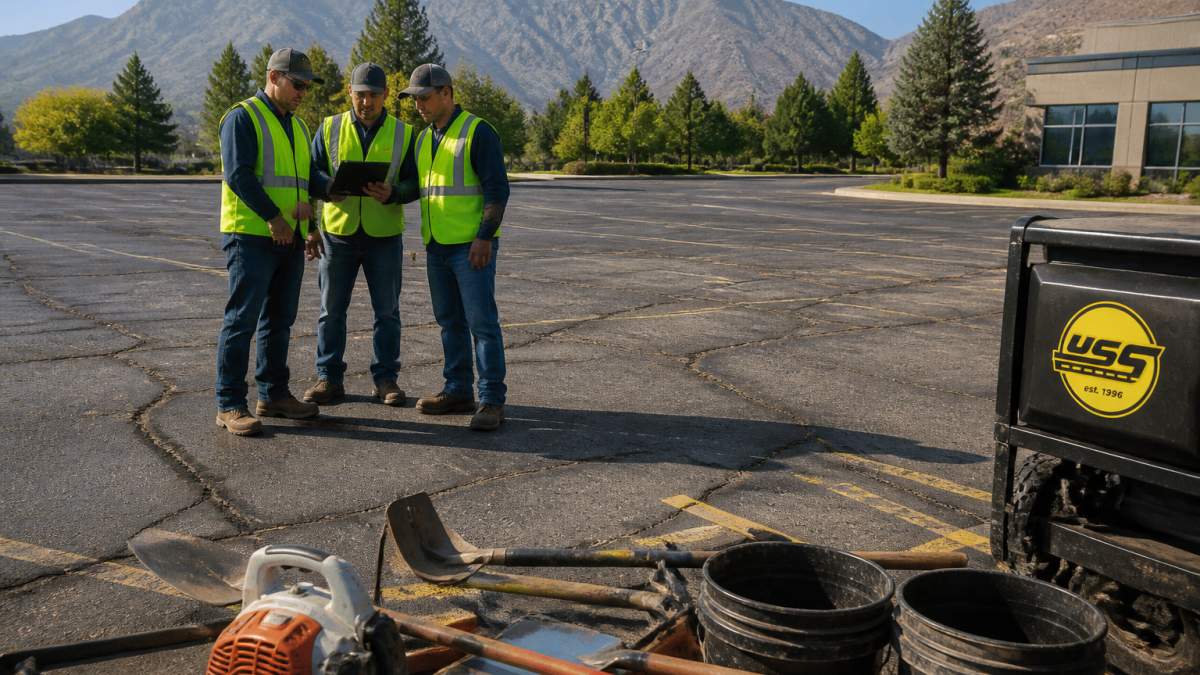
Traffic adds stress that weather alone doesn’t create. Heavy vehicles compress the pavement. Repeated pressure causes the surface to flex and fatigue. Oil drips from engines penetrate the asphalt, softening it.
The combination of weather exposure and traffic load determines how quickly pavement fails:
- Heavy traffic on exposed pavement fails faster than light traffic
- Freeze-thaw cycles cause more damage than stable temperatures
- Surfaces without sealcoating deteriorate 2-3 times faster
- Cracks left unfilled grow exponentially as water enters
Commercial Parking Lot Maintenance: Prevention vs. Crisis Repair
Prevention costs less than crisis repair. Every competitor says it. What most property managers actually need is a way to decide which problem gets fixed this week and which can wait until the next budget cycle.
A practical triage framework sorts pavement distress into four tiers based on severity, water intrusion risk, and safety exposure:
Tier 1, Fix immediately (within days)
- Potholes in drive lanes, loading zones, or any path a pedestrian uses
- Alligator cracking (interconnected cracks forming a skin-like pattern), this signals base failure, and patching alone won’t hold
- Ponding water that sits more than 48 hours after a rain, because standing water migrates into the subbase
- Any crack wider than roughly a quarter-inch, or any crack with visible edge deterioration
- Faded or missing ADA striping, fire lanes, or directional arrows, these are liability items, not cosmetic ones
Tier 2, Schedule within the current season
- Longitudinal and transverse cracks between roughly an eighth-inch and a quarter-inch
- Block cracking across a large area without edge spalling
- Minor raveling (surface aggregate loosening) at the edges of drive lanes
- Drainage grates or catch basins with partial blockage
Tier 3, Bundle into the next planned maintenance cycle
- Hairline cracks under an eighth-inch with no water tracking
- Surface oxidation (graying) without structural cracking
- Faded striping in low-traffic stalls
Tier 4, Monitor and document
- Isolated surface blemishes, minor oil staining, and cosmetic wear that doesn’t affect drainage or load capacity
The operational difference between the two paths is just as important as the cost difference:
- Preventive work is scheduled during off-hours, phased so a portion of the lot stays open, and communicated to tenants in advance. Signage and cones go up the day before.
- Crisis repair is reactive. It often means closing a section of the lot on a weekday, rerouting traffic, and fielding complaints from tenants and customers who weren’t warned.
A common pattern property managers run into: a lot gets no maintenance for four or five years, then needs full-depth reclamation or mill-and-overlay. The same lot on a preventive cycle typically only needs sealcoat refreshes and periodic crack sealing over that same window.
The takeaway: don’t treat every crack the same. Triage by safety, water intrusion, and structural risk, then let the calendar and the budget follow the triage, not the other way around.
Asphalt Crack Sealing: Stop Small Problems Before They Spread
Cracks are the first visible sign that pavement needs attention. A single crack seems minor.
Asphalt crack sealing is the process of filling cracks with specialized materials that prevent water infiltration.
The timing of crack repair matters. Early intervention is the key principle behind why commercial asphalt needs regular maintenance.
Crack sealing works best when:
- Cracks are identified during routine inspections
- Cracks are sealed before winter freeze-thaw cycles
- Cracks are monitored annually to catch new ones
- The pavement receives sealcoating protection afterward
Ignoring cracks leads to alligator cracking, where the entire surface fractures into a pattern resembling alligator skin.
Parking Lot Sealcoating: Extending Pavement Lifespan and Performance
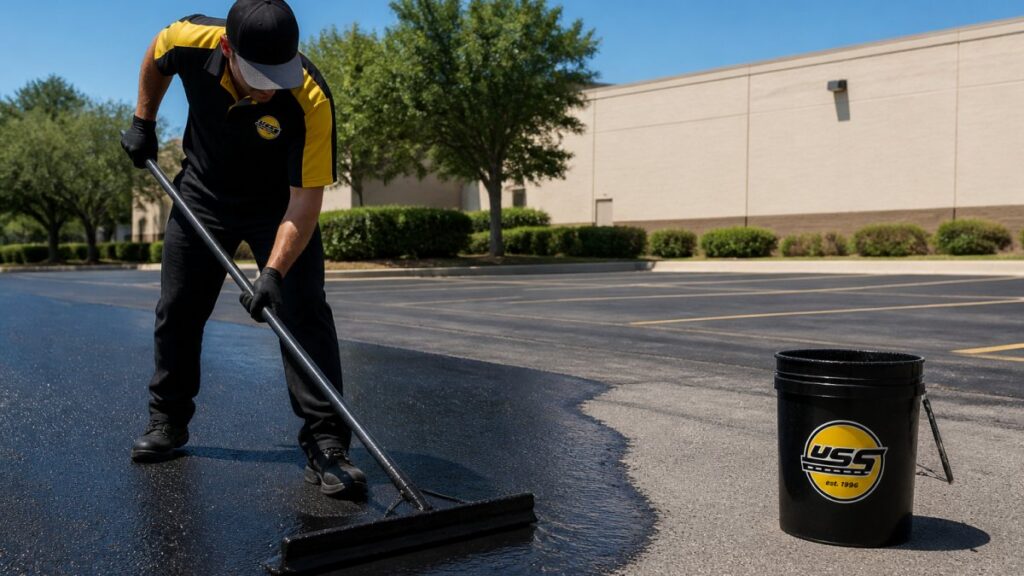
Parking lot sealcoating is a protective layer applied to the asphalt surface. It blocks UV rays, water, and chemicals from penetrating the pavement.
Sealcoating is not optional for commercial properties. It’s essential maintenance. Unsealed asphalt oxidizes rapidly. The surface becomes brittle. Cracks form faster.
The benefits of sealcoating include:
- UV protection that prevents surface oxidation
- Water barrier that stops moisture infiltration
- Chemical resistance to oil and road salt
- Improved appearance and curb appeal
- Extended pavement lifespan by 5-10 years
Most commercial pavement needs sealcoating every 2-3 years, depending on traffic and climate.
Utah Sealcoat & Striping applies sealcoating that protects your pavement and enhances its appearance.
Routine Inspections and Parking Lot Striping Maintenance
Routine inspections catch problems early. A professional inspection identifies cracks, potholes, drainage issues, and surface deterioration before they become expensive.
During an inspection, a professional evaluates:
- Crack severity and location
- Pothole development and size
- Surface condition and oxidation
- Drainage and water pooling
- Striping visibility and wear
Parking lot striping maintenance is often overlooked but critical for safety and liability. ADA-compliant striping requires clear, visible markings for accessible parking spaces and pathways (ADA Compliance Brief: Restriping Parking Spaces).
Striping fades due to UV exposure and traffic wear. Refreshing stripes every 1-2 years maintains safety and appearance.
Routine inspections and striping maintenance work together. An inspection identifies where striping needs refresh. Fresh striping improves safety and appearance. Both tasks are part of a complete maintenance program.
Building a Commercial Pavement Maintenance Plan
A maintenance plan is a multi-year schedule of preventive tasks tied to your property’s traffic, climate, and current pavement condition. Without one, maintenance happens reactively. With one, you know what to inspect, when to treat, and when maintenance stops being enough and rehabilitation becomes the smarter spend.
Inspection frequency by traffic level
Most pavement consultants recommend adjusting inspection cadence to how hard the surface is actually working:
- Heavy-traffic sites (retail centers, grocery-anchored lots, distribution drive lanes): walk the lot twice a year, spring and fall, plus a quick visual sweep after any major storm or freeze-thaw event.
- Medium-traffic sites (office parks, medical campuses, mixed-use): twice a year is still the baseline, but the fall inspection matters most because it sets up winter prep.
- Light-traffic sites (storage facilities, low-occupancy lots, overflow parking): one thorough annual inspection is usually adequate, with a spot-check after winter.
Maintenance timeline by treatment
A workable multi-year cadence for a typical commercial lot looks like this:
|
Treatment |
Typical interval |
Trigger to act sooner |
|---|---|---|
|
Crack sealing |
Annually |
New cracks wider than a quarter-inch, or any crack with edge spalling |
|
Sealcoating |
Every 2-3 years |
Visible oxidation (graying), aggregate exposure, or after any major patching |
|
Striping refresh |
Every 1-2 years |
Faded ADA stalls, worn fire lanes, or after sealcoat application |
|
Pothole patching |
As needed |
Any pothole in a drive lane or pedestrian path |
|
Drainage clearing |
Annually, before winter |
Standing water more than 48 hours after rain |
|
Full-depth assessment |
Every 5-7 years |
Alligator cracking, rutting, or repeated patching in the same area |
Lifecycle planning: when maintenance is no longer enough
Preventive maintenance extends pavement life, but it has a ceiling. Once a surface reaches the point where alligator cracking covers large areas, rutting appears in wheel paths, or the same section needs patching every year, the math flips.
A common lifecycle arc for a well-maintained commercial lot runs roughly 15-20 years before major rehabilitation, with sealcoating and crack sealing carrying the middle years. A neglected lot often needs mill-and-overlay or full-depth reclamation in year 8-12.
Operational planning during maintenance
Disruption is the part most plans ignore, and it’s the part tenants notice most. A few practical rules:
- Phase the work. Never close an entire lot if you can close a third at a time. Sealcoat and stripe in sections, allowing traffic to flow through the untreated portion.
- Communicate early. Notify tenants and neighboring businesses at least a week ahead with dates, affected areas, and alternate parking.
- Post signage the day before. Directional cones, “No Parking” signs, and detour arrows should be in place before the first vehicle arrives on work day.
- Schedule around peak hours. Retail lots: work overnight or early morning. Office parks: weekends. Medical campuses: coordinate with clinic schedules.
- Keep ADA access open. Accessible routes and stalls must remain usable or have a clearly marked temporary alternative.
Measuring whether the plan is working
A maintenance plan without tracking is just a wish list. Four indicators tell you whether the program is paying off:
- Pavement Condition Index trend, if your inspector is scoring the lot, the score should hold steady or improve year over year, not decline.
- Repair frequency, count how many times the same area needs patching. Repeat repairs in one spot mean the underlying issue isn’t being addressed.
- Downtime hours, total hours the lot or a section was closed for repairs. Preventive programs should show low, predictable downtime; reactive programs show spikes.
- Lifecycle cost per square foot per year, total maintenance spend divided by lot area divided by years of service. This is the number that lets you compare a preventive program against a deferred one on equal footing.
Building the plan starts with a professional assessment of your pavement’s current condition, traffic load, and drainage. That assessment becomes the baseline. Every inspection after that either confirms the plan is working or tells you it’s time to adjust.
Conclusion
Why commercial asphalt needs regular maintenance comes down to protection and cost. Asphalt is durable but not indestructible. Weather, traffic, and chemicals wear it down. Regular maintenance slows that wear. It extends pavement life by years. It prevents expensive emergency repairs.
The choice is straightforward: invest in preventive maintenance now, or pay for crisis repairs later. Property managers who understand this principle protect their investment and their budget.
Frequently Asked Questions
How often should a commercial parking lot be inspected?
Commercial parking lots should be inspected at least twice per year—once in spring after winter weather and once in fall before heavy seasonal use. Properties in high-traffic areas or those experiencing extreme weather conditions may benefit from quarterly inspections. Regular inspections catch early signs of damage like small cracks and surface oxidation before they become expensive repairs. Document findings to track pavement condition over time and plan maintenance budgets accordingly.
How does crack sealing help prevent asphalt damage?
Asphalt crack sealing prevents water from penetrating the pavement layers beneath the surface. Water that enters through cracks freezes and thaws with temperature changes, expanding and contracting the cracks until they grow into potholes and structural failures. Sealing cracks early stops this cycle and protects the base layers from deterioration. This preventive approach to asphalt crack sealing is far less expensive than repairing potholes or resurfacing damaged sections later.
What is the difference between sealcoating and crack filling?
Crack filling targets existing cracks by sealing them to prevent water infiltration. Sealcoating applies a protective coating across the entire pavement surface to shield asphalt from UV rays, rain, snow, road salt, and oil drips. Parking lot sealcoating extends overall pavement lifespan by slowing oxidation and surface deterioration. Both are preventive maintenance steps—crack filling addresses current damage while sealcoating protects against future damage across the whole surface.
Why is preventive maintenance better than waiting for major repairs?
Preventive maintenance costs significantly less than major repairs because small issues are inexpensive to fix. A crack filled early costs a fraction of what resurfacing a pothole-riddled section costs. Regular sealcoating and inspections slow deterioration and extend pavement life by years. Waiting for visible damage means the underlying structure may already be compromised, requiring expensive reconstruction. Proactive care also keeps parking lots safe for vehicles and pedestrians while maintaining curb appeal and property value.
Utah Sealcoat & Striping has helped commercial properties across the region build effective maintenance programs. With over 30 years of experience, we understand what keeps pavement in top condition. We offer crack sealing, sealcoating, striping maintenance, and routine inspections. All our work comes with a warranty. Get a free quote today and learn how we can protect your asphalt investment with a maintenance plan designed for your property.
