
Last Updated: October 26, 2026
Quick Summary
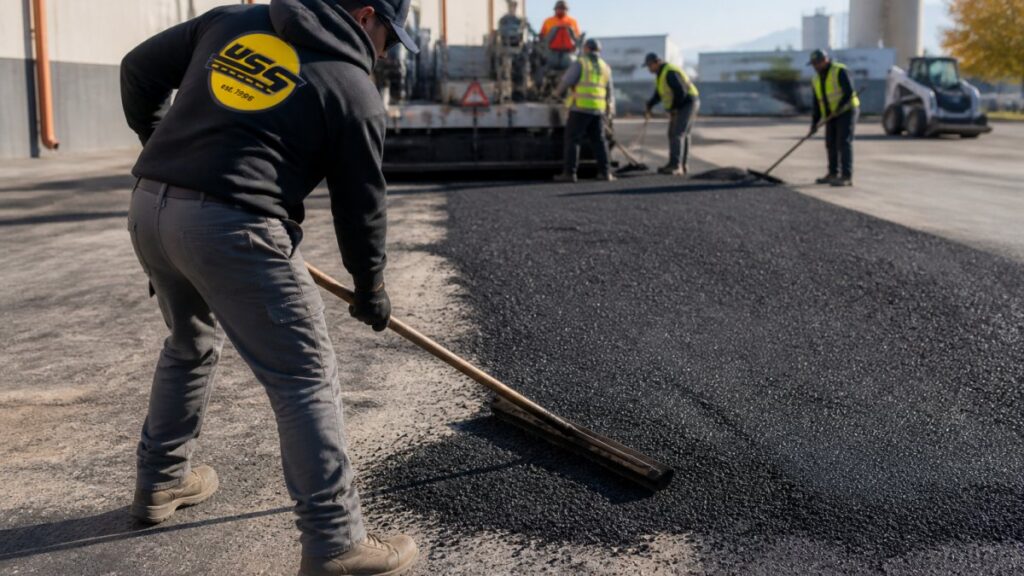
Industrial asphalt repair begins with assessing damage patterns caused by heavy equipment, traffic, and water intrusion, then selecting the appropriate method, patching for surface damage, cut and patch for moderate failures, or full-depth reconstruction for severe base failure. The repair method depends on damage depth, cause, and whether the base layer remains structurally sound.
- Forklifts weighing 5,000 to 10,000 pounds empty concentrate enormous point loads that create localized cracking around loading docks and storage areas.
- Surface scuffing under 1/4 inch deep requires only crack sealant and hand tamping with 1-2 hour cure time, while moderate depressions need saw-cut removal and hot-mix asphalt with 24-hour cure.
- Potholes deeper than 2 inches with base damage require cut and patch or full-depth reconstruction rather than simple patching to prevent rapid re-failure.
- Sealcoating extends pavement life by 5 to 10 years and prevents water intrusion, the root cause of most industrial asphalt damage.
- Cold-mix patches work immediately for emergencies but last only 3-6 months, while hot-mix patches last 2-5 years and are the standard for industrial repairs.
Table of Contents
- Understanding Industrial Asphalt Damage: Assessment and Root Causes
- Forklift Asphalt Damage Repair: Addressing Heavy Equipment Impact
- Asphalt Pothole Repair: When to Patch, Cut, or Resurface
- Asphalt Patching Methods: Choosing the Right Technique for Your Surface
- Asphalt Overlay Over Existing Pavement: When Resurfacing Makes Sense
- Preventive Maintenance and Sealcoating: Extending Pavement Life
- Planning Your Industrial Asphalt Repair Project
- Frequently Asked Questions
Understanding Industrial Asphalt Damage: Assessment and Root Causes
Industrial asphalt repair begins with understanding what’s breaking down beneath your feet.
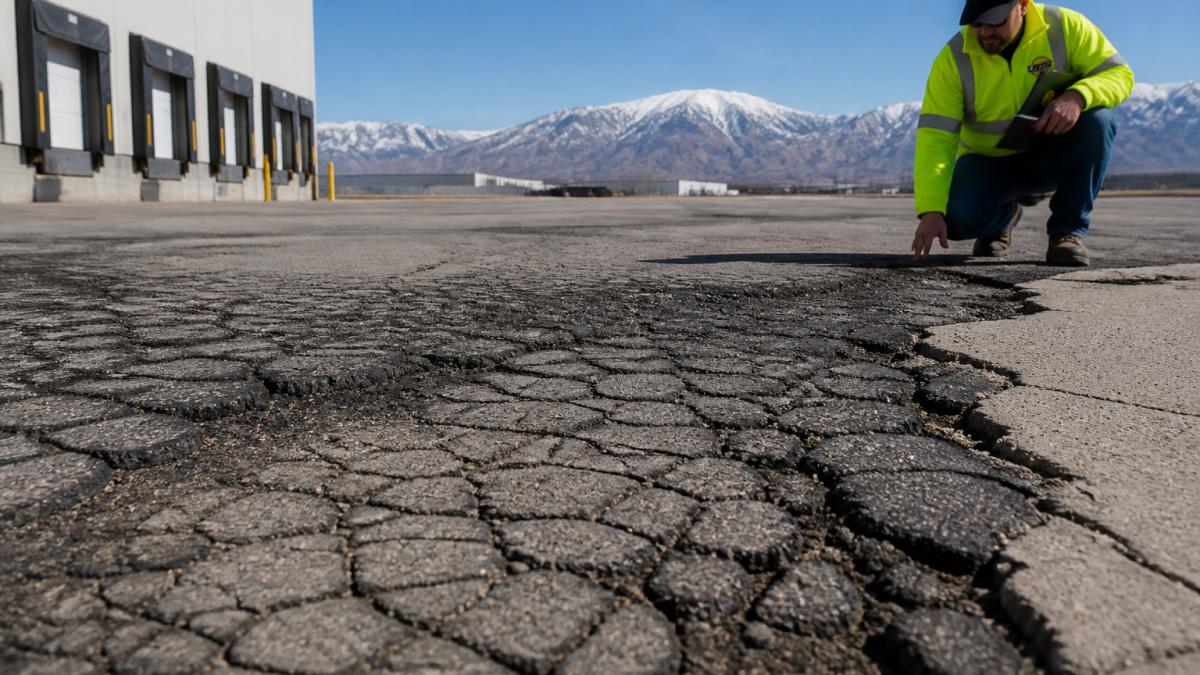
Industrial pavement damage rarely happens by accident. Heavy equipment, constant traffic, weather, and poor drainage accelerate deterioration, identify the worst forces to address them correctly.
Common damage patterns in industrial facilities include:
- Alligator cracking from repeated heavy loads
- Edge cracking where pavement meets unprotected shoulders
- Potholes that form when water penetrates subsurface layers
- Rutting from directional traffic patterns
- Raveling where the surface layer separates from the base
Root cause determines repair strategy.
Before committing to any repair method, walk your pavement and look for these signs:
- Wet spots or standing water, drainage is failing
- Cracks radiating from a central point, heavy load concentration
- Surface spalling, salt damage or freeze-thaw cycles
- Rutting in straight lines, consistent traffic patterns
These patterns help you choose between patching, resurfacing, or reconstruction. A pothole caused by poor drainage needs different treatment than one caused by a forklift.
Forklift Asphalt Damage Repair: Addressing Heavy Equipment Impact
Forklift damage is one of the most common industrial asphalt problems we see, and it’s almost always preventable. Forklifts concentrate enormous weight on small tire contact points, creating stress the pavement wasn’t designed to handle.
A standard forklift weighs 5,000 to 10,000 pounds empty. Add a loaded pallet, and you’re pushing 15,000 to 25,000 pounds through a tire footprint smaller than a sheet of paper, hence the localized cracking and depression around loading docks and storage areas.
Why forklifts damage asphalt faster than other traffic:
- Concentrated point loads instead of distributed weight
- Sharp turns that create shear stress
- Repeated passes over identical paths
- Frequent stops and starts that break the surface bond
- Tire marks that indicate moisture penetration points
Assessing Forklift Load and Traffic Patterns
Before repairing, map forklift routes. Most facilities find 80% of traffic uses 20% of the pavement. Identify those corridors, turning radii, and dock approaches, and note forklift types and loaded weights to decide between localized patching and a structural upgrade.
Damage clusters where forklifts turn or brake, where shear stress exceeds the asphalt’s tensile strength. Patching without addressing the traffic pattern means the repair will fail again.
Step-by-Step Repair Methods by Damage Type
1. Surface scuffing and minor cracking (depth < 1/4 inch):
- Clean the area with a wire brush or power blower.
- Apply a crack sealant or emulsified asphalt patch.
- Compact with a hand tamper.
- Cure time: 1-2 hours before traffic.
2. Moderate depressions or cracking (depth 1/4-1 inch):
- Saw-cut the affected area to a clean rectangle.
- Remove failed asphalt down to sound base.
- Clean and tack the edges.
- Fill with hot-mix asphalt (or cold-mix for temporary).
- Compact in 2-inch lifts.
- Cure time: 24 hours for hot-mix; cold-mix can take traffic immediately but lasts 3-6 months.
3. Severe base failure (depth > 1 inch or widespread alligator cracking):
- Full-depth removal of asphalt and compromised base.
- Re-compact or replace base aggregate.
- Apply new hot-mix asphalt in lifts.
- Consider a geotextile fabric between base and asphalt to distribute load.
- Cure time: 24-48 hours.
Redirect forklift traffic to wider aisles where possible. Distributing loads over a larger area reduces point stress and extends pavement life significantly.
Material Comparison for Forklift Damage Repair
| Material | Best Use | Cure Time | Expected Durability |
|---|---|---|---|
| Cold-mix patch | Temporary fix, emergency | Immediate | 3-6 months |
| Hot-mix asphalt | Permanent patch | 24 hours | 2-5 years |
| Crack sealant | Minor cracks | 1-2 hours | 1-2 years |
| Geotextile fabric | Base reinforcement | N/A | 5-10 years (with overlay) |
For existing forklift damage, clean and seal small cracks immediately; patch larger areas with depression or multiple cracks. Sealing deep cracks without addressing base failure wastes money, the crack reopens within months.
Asphalt Pothole Repair: When to Patch, Cut, or Resurface
Potholes are the most visible pavement failure and the most misunderstood. A pothole isn’t just a hole, it’s evidence water has been working beneath the surface for weeks or months.
Patch versus resurface depends on pothole depth, size, and cause. A shallow pothole from surface spalling can be patched; a deep pothole with jagged edges means the base is failing and simple patching will fail quickly.
Decision Framework: Patch, Mill, Resurface, or Reconstruct
Use this guide to select the right repair method based on damage characteristics:
| Damage Characteristic | Recommended Repair | Rationale |
|---|---|---|
| Pothole depth < 2 inches, isolated | Hot-mix patch | Sufficient for surface-level failures |
| Pothole depth 2-4 inches, base intact | Cut and patch | Removes compromised asphalt, bonds to sound base |
| Multiple potholes in one area (> 3 within 10 ft) | Milling and resurfacing | Addresses widespread surface failure |
| Pothole with alligator cracking extending > 2 ft | Full-depth reconstruction | Base failure requires structural repair |
| Pothole with standing water or drainage issue | Fix drainage first, then reconstruct | Water will destroy any patch |
Step-by-Step Pothole Repair Methods
Cold patch (temporary):
- Remove loose debris and water from the hole.
- Pour cold-mix asphalt, overfilling by 1/4 inch.
- Compact with a plate compactor or truck tire.
- Traffic can resume immediately.
Hot patch (permanent):
- Saw-cut a clean rectangle around the pothole.
- Remove all failed asphalt and loose base material.
- Clean and tack the edges with emulsified asphalt.
- Place hot-mix asphalt in 2-inch lifts.
- Compact each lift with a vibratory roller.
- Cure for 24 hours before opening to heavy traffic.
Cut and patch (base repair):
- Saw-cut to sound pavement.
- Remove asphalt and inspect base.
- Replace or re-compact base aggregate.
- Apply tack coat to edges.
- Fill with hot-mix asphalt in lifts.
- Compact and cure for 24-48 hours.
Patching over a pothole without cleaning and drying it is the most common cause of patch failure. Dirt and moisture prevent bonding.
Material and Method Comparison
| Method | Best For | Cure Time | Durability | Relative Cost |
|---|---|---|---|---|
| Cold patch | Emergency, winter | Immediate | 3-6 months | Low |
| Hot patch | Most industrial repairs | 24 hours | 2-3 years | Medium |
| Cut and patch | Base damage | 24-48 hours | 4-7 years | Medium-High |
| Full-depth reconstruction | Widespread failure | 48-72 hours | 7-10+ years | High |
Timing matters: pothole repair is faster and more effective in warm weather, while cold temperatures mean longer cure times and weaker bonds. In winter, prioritize the largest potholes and plan comprehensive repairs for spring.
Federal Highway Administration guidelines on pothole repair
Asphalt Patching Methods: Choosing the Right Technique for Your Surface
Industrial asphalt patching comes down to temporary fixes versus permanent repairs.
Cold patch is the fastest option, apply it in any weather without heating equipment.
Hot patch uses heated asphalt, which bonds better to the existing surface.
Cut and patch removes the damaged area completely and replaces it with new asphalt.
Federal Highway Administration guidelines on pavement repair
Surface preparation determines success: remove all loose material, keep the area dry, and cut edges cleanly, feathering helps the patch bond to surrounding pavement.
Assess patch durability before choosing a method.
crack sealing service details(page:1)
Asphalt Overlay Over Existing Pavement: When Resurfacing Makes Sense
An overlay applies a new layer of asphalt over existing pavement.
The risk is that overlays hide problems. If the base is failing, the overlay will crack and fail too, water will reach compromised layers below, and you’ll be back to repairs within a few years.
When overlays make sense:
- Base pavement is structurally sound with no major cracking
- Surface damage is primarily from weathering and UV exposure
- You want to extend pavement life for 5 to 10 years
- Budget constraints prevent full reconstruction
- Traffic allows temporary lane closures during application
When overlays don’t work:
- Multiple alligator cracks indicate base failure
- Standing water or drainage problems exist
- Pavement has settled or shifted significantly
- You need a solution lasting 10+ years
Before overlaying, get a professional assessment.
The overlay process is straightforward: clean and slightly roughen the existing surface, apply and compact the new asphalt layer.
sealcoating service details(page:2)
Preventive Maintenance and Sealcoating: Extending Pavement Life
Preventive maintenance is where industrial asphalt repair becomes cost-effective.
Think of sealcoating as insurance: it costs a fraction of repairs and prevents most damage that leads to them.
Benefits of regular sealcoating:
- Extends pavement life by 5 to 10 years
- Prevents water intrusion and base layer damage
- Protects against UV fading and oxidation
- Reduces crack propagation
- Improves appearance and curb appeal
- Costs far less than repair or replacement
The timing of sealcoating matters. It should be applied after the pavement has cured and before major damage develops.
Asphalt Pavement Association maintenance guidelines
Many facility managers delay sealcoating because it seems optional.
Scheduling sealcoating requires planning.
Planning Your Industrial Asphalt Repair Project
Step 1: Document the damage. Walk your entire facility and photograph problem areas. Note the location, size, and type of damage.
Step 2: Prioritize repairs. Not everything needs to be fixed at once.
Step 3: Choose your repair strategy. Based on the damage assessment, decide whether you need patching, overlays, or full resurfacing.
Step 4: Plan the schedule. Industrial facilities can’t shut down for repairs.
Step 5: Get a professional assessment. Don’t rely on contractor estimates alone.
Project planning guidelines for commercial pavement repair
The cost of industrial asphalt repair varies based on damage type, area size, and repair method chosen. Rather than guessing at numbers, get a free quote from professionals who can assess your specific situation and provide accurate pricing.
Frequently Asked Questions
Can you apply asphalt overlay over existing asphalt pavement?
Yes, asphalt overlay over existing pavement is possible when the base layer remains structurally sound. The existing surface must be cleaned, leveled, and any major cracks sealed before overlay application. This method works well for surfaces with surface-level deterioration but intact substructure. However, if the base has failed or shows extensive cracking, full removal and reconstruction may be necessary. A professional assessment determines whether overlay is appropriate for your specific industrial asphalt repair needs.
How do you repair asphalt damaged by forklifts and heavy loads?
Forklift asphalt damage repair depends on damage depth. Surface depressions and minor cracking can be addressed with patching or localized resurfacing. Deep rutting or structural damage requires removing the affected section, inspecting the base layer, and replacing it with new material. High-traffic industrial areas benefit from reinforced asphalt mixes designed to withstand repeated heavy equipment impact. Preventing future damage involves load distribution, traffic management, and regular maintenance inspections.
What determines whether an asphalt pothole should be patched or cut out?
Asphalt pothole repair method depends on pothole size, depth, and surrounding surface condition. Small potholes under 6 inches can often be patched effectively. Larger potholes or those with deteriorated edges require cutting out the damaged section and replacing it with new asphalt. If potholes are frequent or clustered, the underlying issue, usually poor drainage or base failure, must be addressed, which may require resurfacing or reconstruction rather than repeated patching.
How long should asphalt repair cure before heavy traffic returns?
Most asphalt repairs cure sufficiently for light traffic, but industrial asphalt repair with heavy equipment requires adequate time for full strength development. Temperature and humidity affect curing time; cooler or more humid conditions extend curing periods. Premature heavy traffic can displace or damage fresh asphalt, compromising repair longevity. Your repair contractor will provide specific curing timelines based on weather conditions and traffic requirements for your project.
Industrial asphalt repair doesn’t have to be a crisis response. With proper assessment, the right repair method, and preventive maintenance, you can keep your pavement in good condition for years. Utah Sealcoat & Striping brings 30 years of experience to every project, with work backed by warranty and completed on schedule and within budget. Get a free quote today and let’s build a maintenance plan that protects your investment.

