
Table of Contents
- Why Parking Lot Paving Near Me Searches Signal a Bigger Problem
- What to Look for in a Local Paving Contractor
- How Commercial Asphalt Repair Cost Is Calculated
- Asphalt Paving Project Timeline: From Estimate to Cure
- ADA Compliance for Parking Lots: What Property Managers Must Know
- Permitting, Zoning, and Seasonal Timing: What Most Guides Skip
- Repair vs. Replace: Making the Call on Your Parking Lot Paving
- Frequently Asked Questions
Last Updated: September 23, 2026
Why Parking Lot Paving Near Me Searches Signal a Bigger Problem
Searching for parking lot paving near me usually means something has already gone wrong. Maybe a pothole swallowed a shopping cart, or cracks spread through the drive lanes after a hard freeze. Whatever triggered the search, the real issue is rarely just one bad patch of asphalt. It is almost always deferred maintenance catching up all at once.
Utah Sealcoat & Striping has worked on commercial lots, garages, and HOA roads since 1996, and the pattern repeats: property managers wait until pavement failure becomes a liability, then scramble for a contractor during the busiest season.
What to Look for in a Local Paving Contractor
A qualified paving contractor carries current licensing, general liability insurance, and workers’ compensation coverage, and can show proof of all three before work begins. Ask for these documents directly, not just a verbal assurance.
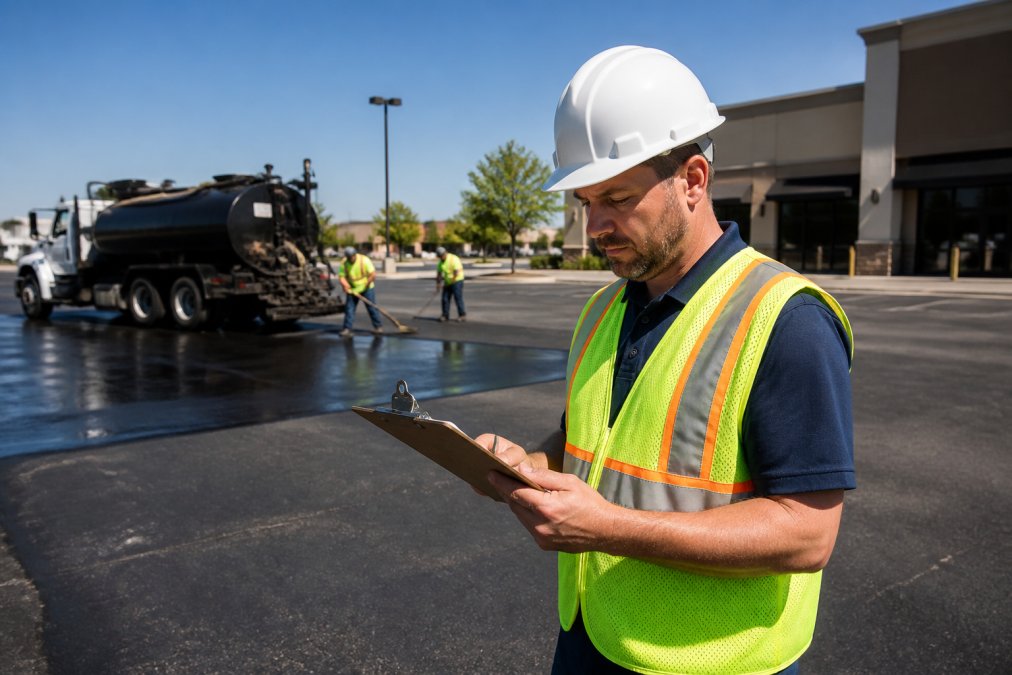
Contractor reviewing plans at a commercial parking lot paving site with a crew working in the background
Licensing, Insurance, and Warranty Coverage
Ask for the contractor’s license number and verify it with your state’s licensing board. Request a certificate of insurance naming your property as an additional insured. A written warranty matters too: get the terms in writing, including what triggers a callback and how long coverage lasts.
Questions to Ask Before You Sign
- How many years have you worked on commercial properties of this size?
- Can you provide references from similar lots in the last 12 months?
- What is your process for site preparation and subgrade compaction?
- Does your warranty cover sealcoat failure, cracking, or both?
- How do you handle scheduling around our operating hours?
A common mistake is skipping the reference call. Ten minutes on the phone with a past client tells you more than any brochure.
How Commercial Asphalt Repair Cost Is Calculated
Commercial asphalt repair cost is not a single number, it is the sum of four measurable inputs: square footage, damage depth, access difficulty, and scheduling window. Understanding how a contractor builds a bid lets you compare proposals on equal footing instead of comparing bottom lines.
The Four Inputs Behind Every Bid
1. Square footage and repair geometry. Contractors measure in square feet for sealcoat and crack fill, but switch to linear feet for crack routing and to cubic yards for full-depth patches. A 200-square-foot pothole that is 6 inches deep is a different job than a 200-square-foot area of surface raveling, even though the footprint is identical.
How the Treatments Compare in Scope
|
Treatment |
What It Fixes |
Relative Cost Tier |
|---|---|---|
|
Working cracks under about a quarter inch |
Lowest |
|
|
Sealcoating |
Oxidation, fading, minor surface wear |
Low |
|
Full-depth patch |
Potholes, base failure in isolated spots |
Mid |
|
Milling and overlay |
Widespread surface failure over a sound base |
High |
|
Full reconstruction |
Base failure, drainage failure, structural loss |
Highest |
Treat the tiers as relative, not as dollar figures. Two lots in the same city can land in different tiers because of subgrade, drainage, and traffic loading.
Lifecycle Cost: The Number Most Bids Leave Out
A low first-cost bid is not the same as a low lifetime cost. A common pattern property managers see is a sealcoat-only approach that saves money in year one and then requires a full mill-and-overlay three to five years earlier than a lot that received crack filling and sealcoat on a regular cycle. Ask each bidder to outline a five-year maintenance plan alongside the one-time repair price.
What to Send With Your Estimate Request
- A site plan or aerial image with the repair areas marked
- Approximate square footage of each area
- Photos of the worst damage, taken in daylight
- Your operating hours and any blackout dates
- Whether the lot has drainage issues after rain
Written quotes should follow a site assessment, not a phone call. A contractor who prices a commercial lot without walking it is guessing, and you will pay for that guess later.
Asphalt Paving Project Timeline: From Estimate to Cure
A typical commercial asphalt paving project timeline runs from one to three weeks depending on scope, weather, and cure time. A small sealcoat job can finish in a day or two, while a full milling and overlay takes longer.
Here is the general sequence:
- Site assessment and written estimate
- Permitting and scheduling
- Site preparation and subgrade work
- Asphalt installation or overlay
- Compaction and curing
- Striping and traffic markings
ADA Compliance for Parking Lots: What Property Managers Must Know
ADA compliance for parking lots requires accessible spaces, correct signage, proper slope, and compliant access aisles, all maintained after striping. Getting this wrong can trigger citations and costly rework.
Permitting, Zoning, and Seasonal Timing: What Most Guides Skip
Most paving pages stop at ‘check with your local office.’ That is not a plan. This section covers what actually triggers a permit, how zoning interacts with lot changes, and a month-by-month maintenance calendar you can hand to a property manager.
When a Permit Is Actually Required
The trigger is almost never the paving itself, it is what the paving changes. A straight reseal or crack-fill on an existing footprint typically needs no permit. The following changes usually do:
- Altering drainage. New catch basins, regrading toward a different outfall, or changes to stormwater flow typically require review.
- Changing impervious surface area. Expanding the lot, adding a drive-through lane, or converting landscaped area to pavement can push a site over a stormwater threshold.
- Changing lot layout or striping counts. Reducing accessible spaces, reconfiguring aisles, or adding spaces can trigger a site-plan amendment.
- Working in a floodplain or overlay district. These districts often add their own review layer on top of the base zoning.
A Month-by-Month Maintenance Calendar
Pavement fails on a schedule. Property managers who work the schedule instead of reacting to it get more years out of the same lot.
- March-April: Post-winter inspection. Mark potholes, spalls, and new cracks while they are still small. Schedule crack filling once overnight temperatures stay above freezing.
- April-June: Sealcoat window opens. Asphalt needs warm, dry conditions to cure, so this is the prime slot for surface treatments.
- July-August: Overlay and mill-and-fill season. Hot weather helps compaction and cure. This is also the best time to address drainage corrections before fall rains.
- September-October: Fall inspection. Clear drains, re-stripe if markings have faded, and address any cracks that opened over the summer.
- November-February: Limited work window. Cold-weather patching is a temporary fix, not a permanent one. Use this period for planning, budgeting, and scheduling spring work.
Why the Calendar Beats Reactive Repair
A reactive approach, wait for a pothole, then call a contractor, almost always lands you in peak season, paying peak pricing, on a compressed timeline. A planned cycle of spring crack fill, early-summer sealcoat, and fall inspection spreads the work across the year, keeps crews available, and catches failures while they are still surface-level. That is the difference between a repair budget and a replacement budget.
Repair vs. Replace: Making the Call on Your Parking Lot Paving
Repair makes sense when damage is surface-level and the base is sound. Replace when you see widespread alligator cracking, sinking, or drainage failure, since these signal structural problems beneath the surface.
A quick way to decide:
- Repair: isolated cracks, minor potholes, faded striping
- Resurface (overlay): worn surface with an intact base
- Replace: widespread cracking, base failure, poor drainage
Frequently Asked Questions
How much does it cost to pave a parking lot?
Commercial asphalt repair cost depends on square footage, damage severity, and whether you need a full overlay or targeted patching. A small lot with minor crack filling and sealcoating costs far less than one needing milling and resurfacing. Request a free estimate from a local contractor who can assess your subgrade, drainage, and load-bearing capacity before quoting. Pricing varies by region and season, so get at least two written bids.
How often should a commercial parking lot be repaved?
Most commercial lots need sealcoating every two to three years and a full overlay or resurfacing every 15 to 20 years, depending on traffic volume, climate, and how well the asphalt was installed. Catching surface degradation early with crack filling and pothole repair extends pavement longevity significantly. Skipping routine parking lot maintenance shortens the life of your asphalt and raises long-term repair costs.
What is the difference between asphalt paving and sealcoating?
Asphalt paving installs or replaces the surface layer using hot mix asphalt over an aggregate base. Sealcoating applies a protective asphalt emulsion coating that shields the surface from UV damage, water intrusion, and chemical spills. Sealcoating does not fix structural problems like alligator cracking or base failure. If your lot has deep ruts or sinking areas, you need pavement repair or resurfacing first, then sealcoating.
How do I prepare my property for a parking lot paving project?
Clear all vehicles from the work zone, notify tenants and staff at least a week in advance, and confirm the contractor’s traffic flow plan so customers can still reach your building. Ask whether the crew will handle striping and ADA-compliant pavement markings on the same schedule. Verify that the contractor has pulled any required permits. A well-prepared site keeps the asphalt paving project timeline on track and avoids delays.
Pavement problems rarely fix themselves, and waiting usually raises the cost. Utah Sealcoat & Striping brings three decades of asphalt maintenance experience, warranty-backed work, and scheduling that works around your operations. Get a free quote and protect your property’s value before the next freeze.
