
Last Updated: November 2, 2026
Quick Summary
To repair asphalt drainage issues effectively, first diagnose whether water pools from a surface grading problem, a failed crushed-stone base, or a broken drainage system, since each needs a different fix. Then remove the failed asphalt, rebuild and compact the base, correct the slope toward the drain, and test with water before signing off.
- Press the wet area: soft or spongy means the base is failing, firm but low means a grading issue.
- Cut clean, straight edges back to firm pavement, even if that means a bigger repair.
- Fill with crushed-stone aggregate in lifts of a few inches and compact each layer.
- Set the drain as the low point and grade toward it from every direction.
- Run a hose over the repair and confirm no puddles remain after the flow stops.
Table of Contents
- Diagnosing Asphalt Drainage Problems Before You Repair
- What Causes Standing Water on an Asphalt Parking Lot
- Inspecting and Removing Damaged Asphalt
- Rebuilding the Crushed-Stone Base and Handling Sunken Asphalt Repair
- Asphalt Grading and Slope Correction to Funnel Water
- Parking Lot Catch Basin Repair and Drain Inlet Upgrades
- Verifying the Repair and Preventing Future Water Damage
- Getting a Free Quote for Professional Drainage Repair
- Frequently Asked Questions
Diagnosing Asphalt Drainage Problems Before You Repair
Water is the enemy of every asphalt surface. Before you pick up a shovel, you need to know why water is pooling on your asphalt parking lot.
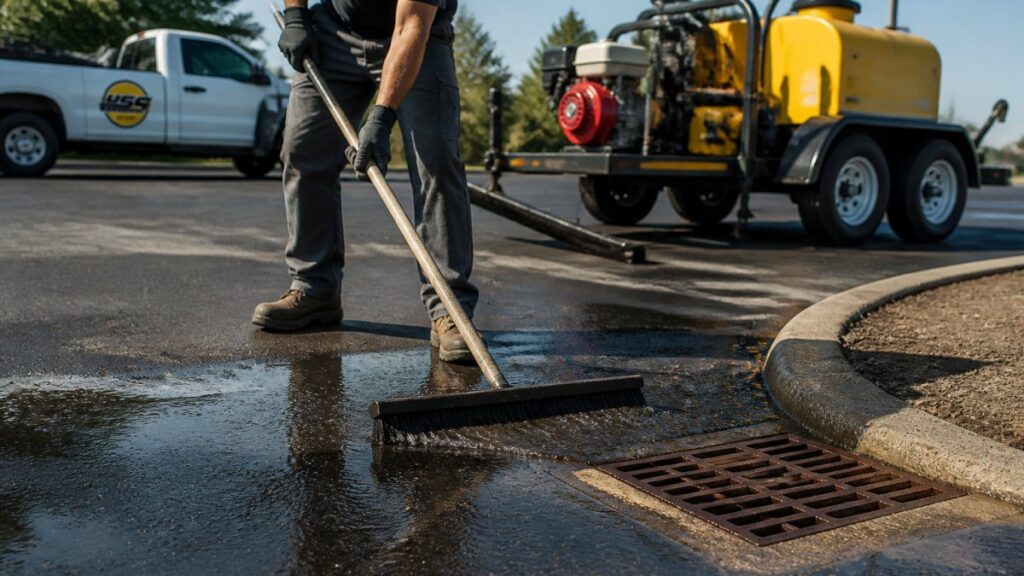
Asphalt drainage repair is the process of finding where water collects, tracing the cause, and correcting the surface or base so water flows away.
Here’s the part most guides get wrong. They jump straight to patching the low spot.
Surface Grading Problems vs. Failed Base or Drainage Infrastructure
The first question is simple: is the problem on top or underneath?
- Surface grading problem: water sits in a shallow dip because the surface no longer slopes toward a drain. The pavement itself is sound.
- Failed base problem: the asphalt sinks or cracks because the crushed-stone base below has settled or turned to mush. Water gets in, and the base gives way.
- Drainage infrastructure problem: a catch basin, inlet, or pipe is clogged, broken, or set too high. Water can’t get in, so it spreads across the lot.
Press on the wet area. If it feels soft or spongy, the base is failing. If it’s firm but low, you have a grading issue. If water sits near a drain that looks clear but still won’t take water, the drain or pipe is the culprit.
The article sorts drainage problems into three sources, each with its own repair path.
| Problem source | What you see | How to confirm |
|---|---|---|
| Surface grading problem | Water sits in a shallow dip; pavement is sound | Area feels firm but low |
| Failed base problem | Asphalt sinks or cracks; base settled or turned to mush | Area feels soft or spongy |
| Drainage infrastructure problem | Catch basin, inlet, or pipe clogged, broken, or set too high | Water sits near a clear-looking drain that won’t take water |
What Causes Standing Water on an Asphalt Parking Lot
Standing water on an asphalt parking lot comes from a few common causes, and most of them build up slowly over years. Here’s what we see most often:
- Settlement: the base compacts unevenly, and the surface dips.
- Clogged drains: leaves, dirt, and debris block inlets and pipes.
- Lost slope: repeated patching and sealant build-up flatten the surface.
- Cracked pavement: water seeps into cracks, softens the base, and speeds up failure.
- Poor original design: some lots never drained well from day one.
A common mistake is blaming the asphalt itself. The asphalt is just the top layer. Water damage almost always starts below or beside it.
Inspecting and Removing Damaged Asphalt
Start the inspection on a dry day.
Once you’ve mapped the problem, remove the failed asphalt. Cut clean, straight edges around the damaged area with a saw.
Watch out: cutting too small leaves weak edges that crumble under traffic.
For larger areas where the damage runs deep, a full asphalt removal and replacement is often the smarter path than piecemeal patching.
Rebuilding the Crushed-Stone Base and Handling Sunken Asphalt Repair
Sunken asphalt repair always means fixing the base first. Dig out the soft, saturated soil and old stone until you hit firm ground.
- Fill with crushed-stone aggregate in lifts of a few inches at a time.
- Compact each layer with a plate compactor or roller before adding the next.
- Check the grade as you build so the finished base slopes toward the drain.
Compaction is the step people skip, and it’s the step that matters most. Loose stone settles under traffic, and the new asphalt sinks right back down.
If you’re dealing with deep base failure across a large industrial surface, our guide to the best method for industrial asphalt repair breaks down the heavier-duty options.
Asphalt Grading and Slope Correction to Funnel Water
Slope correction is how you make water leave. The repaired surface needs a steady fall toward a drain or the lot edge so runoff flows away instead of pooling. Reshape the surface during the repair, not after, grading over a finished surface with a thin overlay just adds dead weight that cracks away from the base.
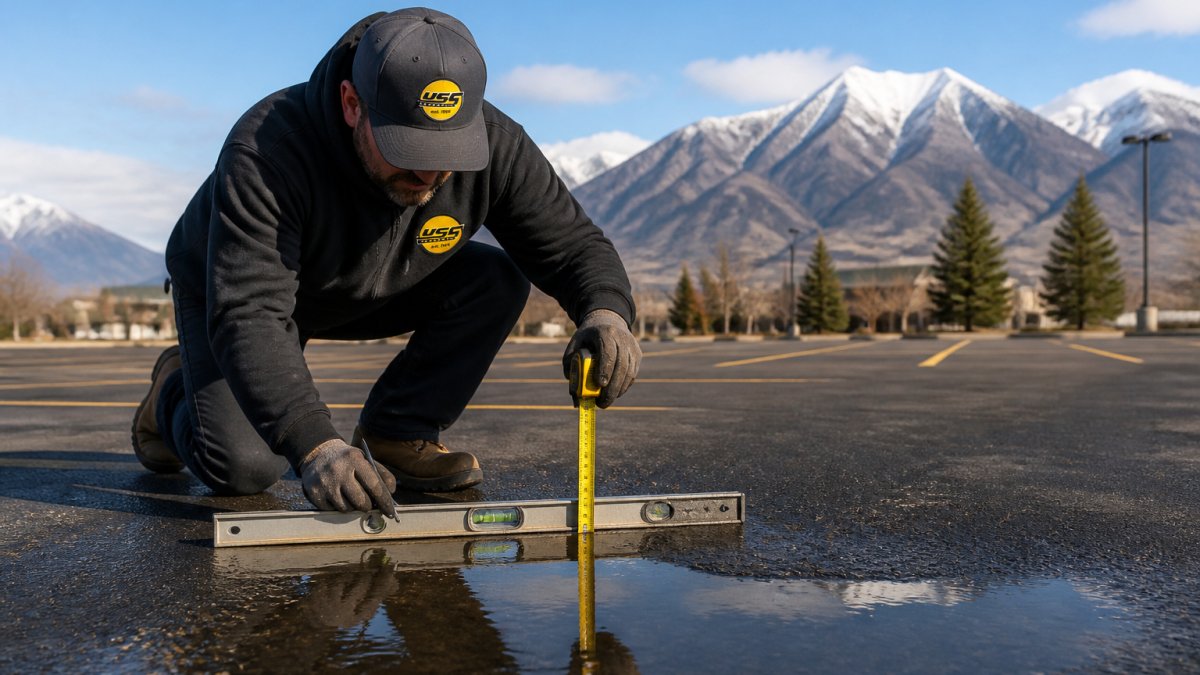
Check the existing fall with a string line or a digital level before you cut anything, so you know how much material you actually need to move.
Plan the Water’s Path Before You Grade
Grading is not just “make it slope.” You are designing a flow path. Work through these decisions in order:
- Pick the outlet first. Identify the catch basin, swale, curb cut, or lot edge where water is allowed to leave. Grade toward that point, not away from it.
- Keep runoff off structures and property lines. Water should never be directed at a building foundation, a retaining wall, a neighbor’s lot, or a public sidewalk where it can freeze or create a liability. Route it to a storm inlet or a designed drainage channel instead.
- Avoid flat spots and counter-slopes. A single dip or a section that falls the wrong way will collect water even if the rest of the lot is perfect. Walk the planned flow path and confirm it falls continuously.
- Respect the drain rim. The inlet rim must sit at or slightly below the surrounding grade so water can enter. A basin set high is a dam, not a drain.
Reshaping During the Repair
Reshape the base, not just the asphalt. After the crushed-stone base is rebuilt and compacted, screed it to the target slope before paving. Then:
- Set the drain as the low point and grade toward it from every direction.
- Keep a consistent fall across the surface so water never has a flat spot to sit in.
- Feather the edges so the new surface blends into the old without a lip that traps water.
- Recheck with a level at several points after compaction, because stone shifts under the roller.
Do not grade water toward a neighboring property or a public right-of-way. Many jurisdictions treat that as a drainage violation, and it can create standing water or ice on someone else’s land. Confirm where runoff is legally allowed to go before you reshape.
Surface grading done right funnels water off the lot in minutes. Done wrong, it just moves the puddle a few feet. If you want to see how the pros handle slope correction, you can grade your asphalt with a team that does it every day.
Parking Lot Catch Basin Repair and Drain Inlet Upgrades
Parking lot catch basin repair fixes the drains that collect the water. A catch basin that’s cracked, clogged, or set too high can’t do its job, and water backs up across the lot.
Clear the debris first. Then inspect the basin walls and the pipe for cracks or breaks.
This is where many DIY repairs stop short. A perfect surface still floods if the drain can’t keep up.
Verifying the Repair and Preventing Future Water Damage
A repair is not finished when the asphalt cools. It is finished when you have confirmed water leaves the surface and the new work stays put. Test before you call it done, then set a monitoring routine.
Test the Drainage
Test the repair with water before you sign off. Run a hose over the repaired area and watch where it goes. Water should move toward the drain or outlet with no puddles left behind after the flow stops.
If water ponds, note where it sits. A puddle in the middle of the new surface means the grade is wrong. A puddle at the drain means the inlet is set high or the pipe is restricted.
Watch for Settlement After the First Rains
New base material settles, and the first few heavy rains are the real test. Check the repaired area after the first significant storm and again after a month of traffic. Look for:
- New low spots or birdbaths where water stands after rain.
- Cracks around the patch perimeter that signal the edge is separating from the old pavement.
- Soft or spongy spots that mean the base is still moving or was not compacted enough.
- Drain inlets that have heaved or dropped out of grade.
Mark anything you find and address it before the next wet season. Small settlement is normal; recurring ponding in the same spot is not.
Match the Material to the Weather
Material choice and timing affect how long the repair lasts. Both patching and sealant perform best in dry, mild conditions, so plan repairs around the forecast rather than fighting it.
Maintenance Routine
Once the repair is verified, keep it working with a simple routine:
- Clear leaves and debris from inlets and grates before rainy seasons
- Seal new cracks each year before water gets in
- Recheck low spots after the first big storm and after winter freeze-thaw
- Keep the surface sealed to slow wear
- Confirm runoff still leaves the lot and is not being redirected onto a neighbor or walkway
Test with water, inspect after the first rains, and fix ponding while it is still a small defect. Drainage repairs fail slowly, catching settlement early is what separates a repair that lasts from one that comes back next spring.
Getting a Free Quote for Professional Drainage Repair
Some drainage repairs are a weekend project. Others need equipment, compaction tools, and a crew that reads water flow for a living. If your lot has deep base failure, broken drains, or water that keeps returning, it’s time to call in help.
When you’re ready, you can get a free quote for the work.
Frequently Asked Questions
Can asphalt be patched to fix a drainage problem?
A patch rarely fixes drainage on its own. Cold patch or an asphalt patch can fill a pothole, but if water still pools in that low area, the patch will fail again within a season or two. Patching works when the base is solid and the low spot is small. When the pooling comes from a failed base, a settled section, or a clogged drain, you need excavation, base rebuilding, or asphalt grading and slope correction instead.
How do you fix standing water on an asphalt parking lot?
Start by finding where the water comes from and where it should go. Check that the slope directs runoff toward a drain inlet or the edge of the pavement, clear any debris from catch basins and pipes, and confirm the base under the low area is not saturated. Standing water on an asphalt parking lot usually points to one of three causes: a low spot from settlement, a blocked drain, or a slope that no longer sheds water. Each needs a different repair.
When should a drainage issue be repaired by an asphalt contractor?
Call a contractor when the low area is larger than a small patch, when the base is soft or pumping, when a catch basin or pipe is cracked or collapsed, or when water flows toward a building or neighboring property. Those jobs need excavation, compaction equipment, and slope work that most homeowners cannot do well by hand. A professional can also confirm whether utilities or permits are involved before digging.
How do you prevent water from damaging asphalt after a repair?
Verify the fix first: watch the repaired area through the next heavy rain and confirm water drains away instead of pooling. Keep catch basins and drain inlets clear of leaves and sediment, seal cracks before winter, and re-check low spots each spring. A fresh sealcoat slows surface deterioration but does not correct grade, so schedule drainage repairs before sealcoating rather than after.
Water damage never fixes itself, and every storm makes a bad drainage problem worse. If your lot keeps pooling after the rain, Utah Sealcoat & Striping can trace the cause and repair it right. You get 30 years of experience, work backed by a warranty, and a crew that shows up on time and on budget. Get started with Utah Sealcoat & Striping and get your pavement draining the way it should.

