
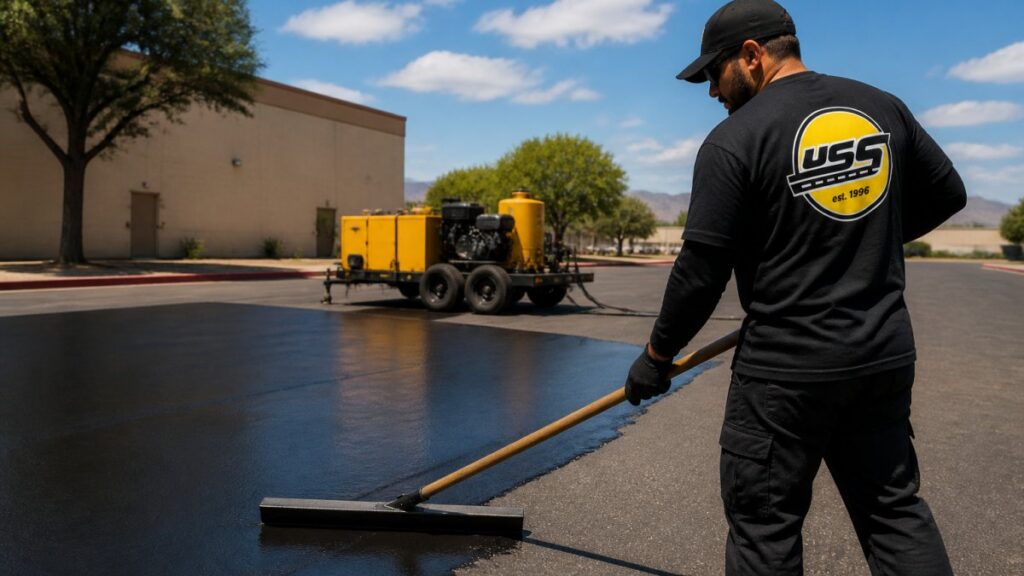
Last Updated: October 28, 2026
Quick Summary
Professional asphalt sealcoating is a surface treatment that protects pavement from water, oxidation, and traffic wear. It works best as one part of a larger maintenance plan, and it should follow crack sealing and be done only on pavement without structural failure.
- Power blowing, sweeping, and degreasing oil stains are done before the sealer goes down.
- Crack sealing should be scheduled ahead of the sealcoat date so the filler can cure fully.
- Ask for the full scope in writing, not just “sealcoat and stripe.
- Confirm the application method for each area, since spray-only bids on rough surfaces can look thin.
- Restrict access during the cure window and stripe only after the sealer has fully cured.
Table of Contents
- What Professional Asphalt Sealcoating Services Include
- Sealcoating Preparation Checklist Before the Crew Arrives
- Asphalt Crack Filling Before Sealcoating: Why the Order Matters
- Materials, Application Methods, and Cost Drivers
- Asphalt Sealcoating Curing Time After Application
- How to Compare Asphalt Sealcoating Contractors
- Booking Your Sealcoating Project With Utah Sealcoat & Striping
- Frequently Asked Questions
What Professional Asphalt Sealcoating Services Include
Professional asphalt sealcoating is a surface treatment that protects pavement from water, oxidation, and traffic wear. At Utah Sealcoat & Striping, we treat it as one part of a larger maintenance plan, not a standalone cosmetic fix.
Most property owners expect a dark, uniform finish. The real value sits in the steps before the sealer goes down.
Our sealcoating scope typically includes:
- Power blowing and sweeping to remove dirt, loose aggregate, and debris
- Degreasing oil stains so the sealer bonds to the pavement
- Crack sealing as a companion service, handled through our [page:1] option
- Application of the sealer in one or more coats, depending on the surface condition
- Striping once the sealer has cured, if the lot needs refreshed markings
Ask any provider to put the scope in writing. A proposal that lists only “sealcoat and stripe” leaves too much open to interpretation.
Best for: Commercial lots and HOA common areas that need a consistent, protective surface.
Skip if: The pavement has structural failure, such as deep alligator cracking or heaving, which needs repair before any coating.
Sealcoating Preparation Checklist Before the Crew Arrives
!A crew member in a high-visibility vest and hard hat sweeping debris from a commercial parking lot with a stripe of fresh pavement marking visible in the background, mountain backdrop under a clear sky
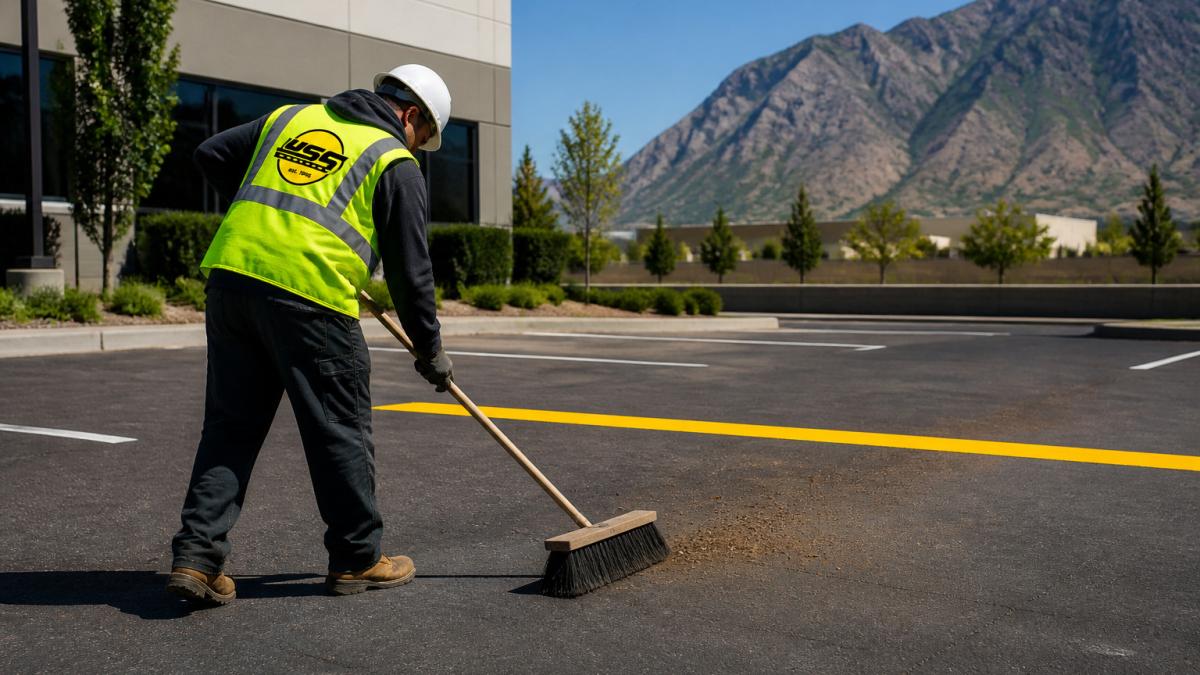
A short checklist helps property managers prepare for the day of the job. Our step-by-step guide to preparing asphalt for sealcoating walks through each task in order.
Asphalt Crack Filling Before Sealcoating: Why the Order Matters
A common mistake is treating crack filling as optional to save money. The sealer then covers the cracks visually, which hides the problem until water damage shows up again. Our crack sealing work is available as a separate service, and we recommend scheduling it ahead of the sealcoat date so the filler can cure fully. Our guide on how to identify asphalt cracks needing repair explains which cracks need attention first.
Materials, Application Methods, and Cost Drivers
Application method matters as much as the product:
- Spray application is fast and covers large lots efficiently, but overspray and drift require careful masking of curbs, storm drains, and adjacent surfaces.
- Squeegee application works the material into surface voids and small cracks, producing a denser film, but it is slower and labor-intensive on large areas.
- Combination spray-and-squeegee is common on commercial lots: squeegee on high-wear lanes and spray on open parking fields. Ask which method will be used on which areas, because a spray-only bid on a rough surface may look thin after cure.
Request a quote through the Utah Sealcoat & Striping website.
The article compares three application methods, each suited to different lot conditions.
| Method | Best for | Key difference |
|---|---|---|
| Spray application | Large lots | Fast, but needs masking to limit overspray |
| Squeegee application | Surface voids and small cracks | Denser film, but slower and more labor-intensive |
| Combination spray-and-squeegee | Commercial lots | Squeegee on high-wear lanes, spray on open fields |
Asphalt Sealcoating Curing Time After Application
Plan for restricted access during the cure window and confirm the exact timing with your contractor before the work starts. Striping should wait until the sealer has fully cured, or the paint may not bond correctly.
How to Compare Asphalt Sealcoating Contractors
Most bids look similar on paper. The differences show up in what is written down, what is left out, and how the contractor handles the questions you ask before signing. Use the framework below to compare proposals side by side rather than by total alone. For a deeper look, see our guide on choosing an asphalt sealcoating contractor.
One customer described the experience as “one of the best experiences I’ve had with a contractor in my life.”
Booking Your Sealcoating Project With Utah Sealcoat & Striping
Our team has more than 30 years of experience in asphalt maintenance and pavement striping, and every service we perform includes a warranty. We keep communication open throughout the project and work around your schedule, which matters for property managers and HOAs with tight operating windows.
If you are ready to plan the work, request a free quote through our website. If your lot also needs fresh markings, our striping services can be scheduled alongside the sealcoat.
Frequently Asked Questions
What do professional asphalt sealcoating services include?
Ask each provider to spell out exactly which steps are included in its quote, since scope varies between companies. Request a free quote from Utah Sealcoat & Striping.
How long does asphalt sealcoating take to cure after application?
Sealcoat needs time to cure before vehicles and foot traffic return, and the exact window depends on weather, temperature, humidity and how many coats were applied. Warm, dry conditions speed curing, while cool or damp weather slows it. Most contractors ask that you keep vehicles off the surface for a set period after application and mark the lot as closed while it dries. Follow the curing instructions your contractor gives you, and avoid driving on fresh sealer, since tire marks and tracking can be difficult to fix once the surface hardens.
How do I choose a reliable asphalt sealcoating contractor?
Start by confirming the contractor carries current liability insurance and workers’ compensation coverage, and ask for proof before work begins. Request references from similar properties, such as commercial lots or HOA roads, and ask how long the company has been in business. Compare written estimates that list the same scope, including crack filling, number of coats and striping. Look for a clear warranty in writing, and ask what it covers and how long it lasts. A contractor that explains the preparation steps and answers scheduling questions directly is usually a better sign than the lowest bid alone.
Can sealcoating repair cracks and potholes?
Sealcoating itself does not repair structural damage. It protects a surface that is in reasonably good condition by sealing small hairline cracks and shielding the asphalt from water and sun. Larger cracks should be filled before sealcoating, and potholes or failed sections need patching. Filling cracks first gives the sealer a sound surface to bond to and keeps water from working its way underneath. Ask your contractor to inspect the pavement and recommend which repairs should be done before the sealer goes on.
Get started with Utah Sealcoat & Striping to protect your pavement, refresh its appearance, and keep the project on time and within budget.

